
Sales management in transition – how do you move from tracking goals to building the future?
Introduction – why sales management can no longer be just about tracking metrics
The new year has begun and many sales managers have returned to their familiar routine: calendars are filling up with meetings, dashboards are flashing red and green, and attention is drawn to reporting. The goals are clear and the scoreboard is at zero after New Year's Eve, but something still feels missing. Sales It seems to be rolling – or at least just staying together – but the direction doesn't seem clear.
Sales Direction has already moved back to a stage where simply tracking goals is no longer enough. Markets are changing, the global economy is swaying like a lone pine tree in a storm, customer expectations are alive, and the work of the sales team is becoming more complex. At the same time, more is expected of the sales leader than ever: the ability to build the future, not just react to the past.
That's why we're getting to the point now. So what? The transformation of sales management means in practice and how a sales manager can move from monitoring metrics to strategic, a role in building the future.
The transformation of sales management: why the old model is no longer enough
Traditional sales management relies heavily on numbers. It has largely been about setting goals, tracking performance, and addressing deviations. This model has worked in a world where sales were more predictable and customer needs were more constant.
The operating environment is different now. Customers are buying products less often and solutions more often. Decision-making is decentralized, sales cycles are longer and competition is fiercer. At the same time, salespeople are expected to have business expertise, the ability to have strategic discussions and the courage to challenge the customer.
If sales management focuses only on chasing results, a reactive culture can easily arise:
- sales are made under quarterly pressure
- focus narrows to short-term trades
- learning and development take a back seat
From tracking goals to showing direction
So the transformation is not just in the operating environment – it is in the way of thinking. Future-oriented sales management does not abandon goals, but changes their role. Goals are no longer the main thing, but a consequence of the right direction.
The key question is not only “Will we achieve our goals?” but:
- what kind Are we building sales?
- in what kind Do we want to succeed in customer relationships?
- what What skills does the future require of us?
As the sales manager takes on the role of a leader, leadership begins to answer these questions. For example, it means:
- The strategy is concretely linked to everyday sales
- Sales are driven by customer relationships, not just euros
- discussions focus on learning, not just the result
In this case, sales meetings are not just reporting sessions, but places where a shared understanding of the future is built. They aim to understand the world of customers and customers' customers, which may not yet exist, but to which, by reacting correctly and in a timely manner, we can get closer to transformative sales.
Building the future in everyday sales management
Building the future is not a separate sales management strategy process that happens once a year. Building the future happens in everyday life, in small choices and conversations.
On a practical level, this is reflected, for example, in how a sales manager spends his time:
- How much time does it take to analyze the past?
- How much time is spent thinking about the future?
Research and practical experience show that effective sales leadership is largely built on questions, not answers. The sales leader is no longer the one who knows everything, but the one who helps the team think better.
For example:
- What is really changing in the customer's business?
- What should we invest in now to be relevant in two years?
- What additional skills does our sales team need?
When these questions come up regularly in conversation, sales begin to develop systematically, not randomly or based on the past.
Concrete priorities for sales leaders in a time of change
Transformation does not require a complete overhaul. Often, it is enough for the sales manager to clarify a few key priorities.
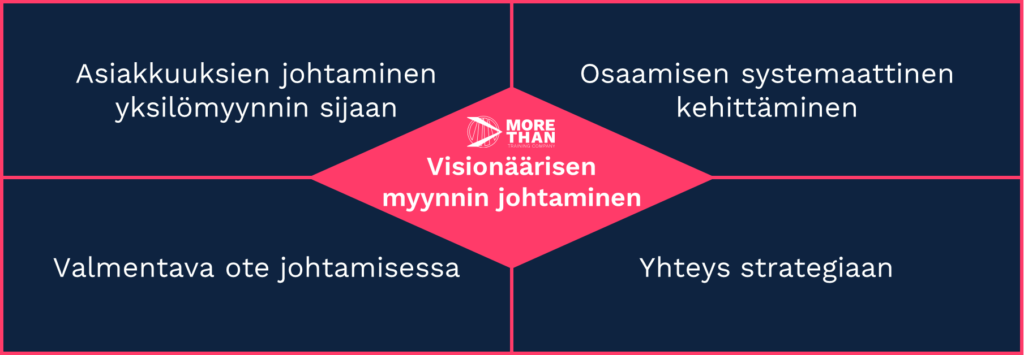
Managing customer relationships instead of individual sales
The focus is shifting from individual deals to long-term customer relationship development. This means that sales are managed, for example, by customer segments and customer-specific goals, and not just by salespeople's personal numbers.
Systematic development of competence
The sales of the future requires new skills: business understanding, interaction skills and the ability to create value in conversation. The sales manager's task is to make learning a part of everyday life and, if necessary, create a systematic approach that prevents learning from slipping away.
A coaching approach to leadership
Instead of leading through control, we lead through trust and responsibility. Coaching Leadership increases both performance and commitment in sales.
Connection to strategy
Sales is not an isolated function, but one of the most important, if not the most important, implementers of strategy. When the sales team understands where the company is headed and why, what they do becomes meaningful and the entire company's operations naturally begin to shift more towards working in line with the strategy.
Summary – the most important question for a sales manager right now
Sales management is in a transition where the old model is no longer viable. Tracking goals is still important, but it cannot be the core of management.
A sales manager building the future regularly stops at one question:
Am I leading the past or building the future?
The answer doesn't come from a single decision, but from everyday actions. From where attention is focused, what kinds of conversations are held, and what kind of thinking is reinforced in sales.
When sales management moves from reactive reporting to proactive, strategic direction, sales not only achieves its goals. Proactive and visionary sales management builds a sustainable competitive advantage for the future.